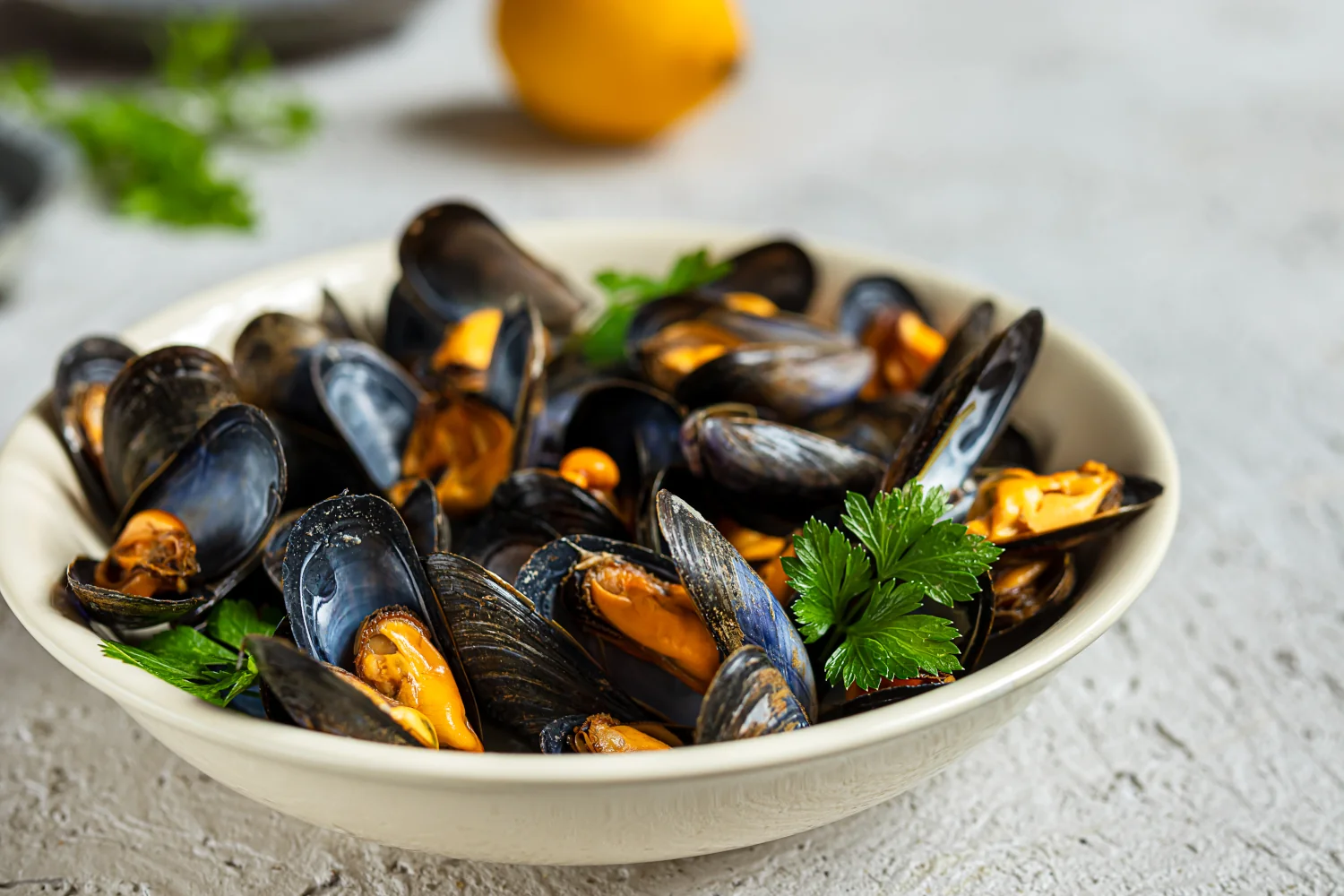
There is something quietly magnificent about a bowl of mussels. Steam rising, shells glistening, a broth below that smells of the sea and something richer — garlic, wine, the work of a good cook. It costs almost nothing. It takes minutes to make. And yet, done well, it is one of the most satisfying things you can eat. The mussel has fed European civilisations for thousands of years, nourished the poor and delighted the wealthy, survived wars and famines, and somehow managed to remain both utterly ordinary and endlessly compelling. It deserves far more credit than it gets.
Let us give it some.
A Shell on Every Shore: The Ancient History of Mussel Eating
Long before anyone thought to add white wine or shallots, Europeans were eating mussels straight from the rock. Archaeological evidence from coastal sites across the continent tells us that mussels were a dietary staple as far back as 20,000 years ago. Shell middens — ancient rubbish heaps composed almost entirely of discarded shellfish shells — have been found along the coasts of Portugal, Spain, Ireland, Scandinavia, and the British Isles, each one a small monument to the appetite of our ancestors.
The ancient Greeks and Romans were enthusiastic mussel eaters, and their writers treated shellfish with genuine enthusiasm. Apicius, the first-century Roman author of De Re Coquinaria, the oldest surviving cookbook in the Western world, included recipes for mussels cooked with leeks, cumin, and wine — a preparation that, in its essential logic, is not far removed from a modern moules marinières. The Romans, never ones to do things by halves, established early forms of mussel cultivation along the Italian coast, creating artificial beds to ensure a reliable supply for their urban markets.
In northern Europe, where the Atlantic coastline provided mussels in almost incomprehensible abundance, the shellfish became a cornerstone of coastal diets throughout the medieval period. Catholic fasting laws, which prohibited the eating of meat on Fridays and throughout Lent, created an enormous demand for seafood, and mussels — cheap, plentiful, and easy to harvest — answered that demand perfectly. Monasteries along the French and Belgian coasts developed early techniques for mussel cultivation, partly out of piety and partly out of practical necessity.
The Legend of Monsieur Walton and the Birth of Mussel Farming
Here is one of food history’s most charming stories, and like many charming stories, it exists somewhere on the blurry border between fact and legend.
In 1235, according to Belgian and French historical accounts, an Irishman named Patrick Walton was shipwrecked off the coast of what is now the Charente-Maritime region of western France, near the Bay of Aiguillon. Stranded and resourceful, Walton planted wooden poles in the shallows to support nets for catching seabirds. He noticed, over time, that mussels were colonising the poles spontaneously, growing in dense, healthy clusters above the muddy seabed. He had stumbled upon the fundamental principle of bouchot mussel farming — the method in which mussels are cultivated on wooden stakes driven into tidal flats — entirely by accident.
Whether the story is entirely true matters less than what it represents: the recognition, centuries ago, that mussels could be farmed as well as gathered. The bouchot method that Walton allegedly discovered is still used in France today. Moules de bouchot, cultivated along the Atlantic coast from Normandy down to the Vendée, carry a Label Rouge quality designation and are considered among the finest mussels in the world. They are smaller than wild mussels, with a sweeter, more concentrated flavour, and their flesh fills the shell in a way that puts the sprawling, watery specimens sold in lesser establishments to shame.
Belgium and the Netherlands: A National Obsession
If one country can claim the mussel as its own, it is Belgium, and the Belgians would not hesitate to make that claim. Moules-frites — mussels and chips — is not merely a popular dish in Belgium. It is, by many accounts, the national dish, a culinary identity marker as powerful as fish and chips in England or pasta in Italy.
The Belgian relationship with the mussel is fierce, proud, and remarkably specific. The mussels must come from Zeeland, the southwestern province of the Netherlands whose tidal estuaries produce shellfish of legendary quality. Zeeland mussels, fattened on the nutrient-rich waters of the Oosterschelde, are larger and more robust than their French bouchot cousins, with a full, briny flavour that pairs magnificently with the Belgian tradition of cooking them in a large pot with celery, onion, and occasionally cream or beer. The chips alongside, cooked twice in beef dripping in the Belgian fashion, are not an afterthought — they are half the point.
Brussels alone has dozens of restaurants dedicated almost entirely to mussels, and during mussel season, which runs traditionally from July through February, the city consumes them with a devotion that borders on the ceremonial. A Belgian friend once told me, with complete seriousness, that the first moules of the season is an event in her family comparable to the first Beaujolais Nouveau in France. I believed her entirely.
The Dutch, meanwhile, are no less devoted. The Netherlands produces around 50,000 tonnes of mussels per year, the majority from Zeeland, making it one of the largest mussel-producing nations in Europe. Dutch mussels are exported across the continent and eaten at home with equal enthusiasm. In the Netherlands, raw mussels — eaten fresh from the shell at harbour-side stalls, with or without a dab of mustard — are as natural a street food as a hot dog in New York.
France: The Art of Moules Marinières
No dish captures the French genius for turning simple ingredients into something transcendent quite like moules marinières. The recipe, at its purest, involves almost nothing: mussels, white wine, shallots, garlic, butter, parsley, and perhaps a breath of cream if you are feeling indulgent. Yet the result, eaten with good bread for the broth and a cold glass of Muscadet beside it, is among the most perfect things the French kitchen has produced.
The dish is Norman and Breton in its origins, born along a coastline where mussels grew in abundance and white wine was the local drink. It spread southward and eventually into the Parisian brasserie culture of the nineteenth century, where it became a fixture of the working-class lunch. Today it appears on menus from Brittany to Nice, from the humblest seaside café to restaurants with stars beside their names.
French chefs have elaborated on the basic template with characteristic thoroughness. Moules à la crème replaces the wine with cream and adds a softness to the broth. Moules au roquefort introduces the famous blue cheese of the Aveyron in a combination that sounds outrageous and tastes magnificent. Moules au curry, beloved in the north, speaks to the historical connection between France and its former colonial territories. Each variation is essentially a conversation with the original, an argument about what the mussel can absorb and become.
Galicia and the Spanish Atlantic: A Different Shore
Spain’s relationship with mussels is centred on Galicia, the green, rain-soaked region in the country’s northwestern corner, where the Atlantic meets a coastline of deep river inlets called rías. The rías of Galicia are among the most productive shellfish habitats in the world, their cold, clean, plankton-rich waters producing mussels, oysters, and clams in extraordinary quantities.
Galician mussels — mejillones — are cultivated on floating rafts called bateas, wooden platforms suspended in the rías from which long ropes hang into the water. Mussels colonise the ropes and grow to impressive size in the rich tidal current. Galicia produces roughly 250,000 tonnes of mussels per year, making it the largest mussel-producing region in Europe and one of the largest in the world.
The Galician approach to cooking mussels is different from the French or Belgian. Simplicity is the guiding principle: mussels steamed open and served with a few drops of lemon juice, or al vapor with a little white wine, or stuffed with a sofrito of tomato, onion, and peppers and returned briefly to the heat. The flavour of the mussel itself is considered paramount. Anything too elaborate is viewed with suspicion, the culinary equivalent of putting lipstick on a painting by Goya.
Tigres — mussels stuffed with a spiced béchamel, breaded and deep-fried — are the brilliant exception to this rule and a beloved tapa across northern Spain. The name means tigers, a reference presumably to the ferocity of the flavour. They are addictive in a way that is difficult to explain and impossible to resist.
The British Isles: An Overlooked Love Affair
Britain and Ireland have some of the finest mussel waters in the world, and for much of their history, both nations knew it. Cockney pearly kings and queens ate jellied mussels from street barrows in Victorian London. The fishing towns of Wales, Scotland, and Ireland relied on mussel harvest as a significant part of their coastal economy.
Then, somewhere in the twentieth century, Britain largely forgot. The mussel became a food associated with poverty rather than pleasure, overshadowed by the dominance of fish and chips and later by the arrival of fast food culture. It lingered on menus, respected but rarely celebrated.
The revival, when it came, was genuine and thorough. British chefs returning from stages in France and Belgium brought back an enthusiasm for moules-frites that gradually filtered from restaurant kitchens into home cooking. Scotland’s Shetland and Orkney Islands, whose cold, pristine waters produce mussels of extraordinary quality, began to attract serious culinary attention. Today, British mussels — particularly those from Scotland and the west coast of Ireland — are exported to France and Belgium, where they are received with the kind of respect that would have astonished a British mussel seller of fifty years ago.
The Nutritional Argument: Why the Mussel Is Having a Moment
Beyond culture and history, the mussel has another powerful argument in its favour: it is extraordinarily good for you, and it may be one of the most sustainable animal proteins on the planet.
A 100-gram serving of cooked mussels provides roughly 24 grams of protein, more than the equivalent weight of chicken or beef. They are rich in vitamin B12, selenium, manganese, and zinc, contain significant amounts of omega-3 fatty acids, and are low in calories and saturated fat. For anyone interested in eating well in every sense, the mussel is close to ideal.
The sustainability case is even more compelling. Mussels are filter feeders, drawing their nutrition directly from the water around them and requiring no feed input whatsoever. They actually improve water quality by filtering out excess phytoplankton and particulate matter. They need no fresh water, no land, no fertiliser, and no pesticide. Their carbon footprint is a fraction of that of any land-based protein. In a world increasingly conscious of the environmental cost of what we eat, the mussel presents itself as a near-perfect food: delicious, nutritious, ancient, and almost entirely benign.
A Few Facts Worth Knowing at the Dinner Table
A mussel can filter up to 65 litres of water per day, removing bacteria and algae as it feeds. The blue-black shell that we discard so casually is a marvel of natural engineering, stronger relative to its weight than most synthetic materials. Mussels are hermaphroditic as juveniles and develop a definitive sex as they mature, which may explain why they have always seemed slightly mysterious. A closed mussel that refuses to open during cooking is not necessarily dead — it may simply have a stronger adductor muscle. However, any mussel that is already open before cooking and fails to close when tapped should be discarded without hesitation.
And perhaps the best fact of all: the French consume around 80,000 tonnes of mussels per year. In a country of approximately 68 million people, that is a serious commitment to a small black shell.
The Last Word
The mussel is not a glamorous creature. It clings to rocks and ropes in cold, dark water, filtering its food from whatever the tide brings in. It has no great beauty to recommend it, no drama, no mythology beyond the charming legend of a shipwrecked Irishman on a French beach eight centuries ago.
And yet. Sit down to a pot of moules marinières with a half-baguette and a cold glass of wine on an autumn evening, and the world contracts to something very simple and very good. The mussel has been doing this for Europeans for twenty thousand years — feeding them, sustaining them, occasionally delighting them.
That is a record worth celebrating.